Proposal · DigitalDifficulty hardReading time: 8 min
It touches the daily work of every office, file formats and line-of-business systems: years, training and a body above the single municipality.
Public money, public code
In 2026 the Municipality of Saronno spent about €56,000 on one year of Microsoft 365 licences. Equivalent programs also exist as free software, and Italian law has required for years that they be assessed before buying. This page does not pick one suite over another: it shows what is spent, which roads other administrations have taken, from Switzerland to Germany to the Province of Perugia, how much they saved and where they met obstacles. The proposal is that the assessment be done for real, and in public.
The idea in brief
- The Digital Administration Code requires reuse and free software to be assessed before buying licences: the first step is asking the Municipality whether it did.
- In 2026 the Municipality paid €55,824 for one year of 251 Microsoft 365 Business Premium licences, about €222 per workstation: that is the order of magnitude at stake every year.
- Free alternatives exist and are in use: openDesk in the Swiss Confederation and in Germany, Nextcloud with Euro-Office or Collabora, LibreOffice on individual PCs. Which to choose is for the comparative assessment the law already requires, not for this page.
- GNU/Linux on the computers Windows 11 would send to landfill after the end of Windows 10 support, and reuse from the Developers Italia catalogue before every new purchase.
- Elsewhere it has already saved money: €227,568 certified for the Province of Perugia, about €15 million a year for Schleswig-Holstein, €2 million a year for the French Gendarmerie.
The starting point
A deadline and a dependency
On 14 October 2025 Microsoft ended mainstream support for Windows 10. In the European Union free security updates continue until 14 October 2026; after that, a computer with Windows 10 is left without fixes. Windows 11 will not install on many PCs from 2018 or earlier that work perfectly well. The choice facing administrations is to buy new computers to run the same word processor, or to change the program and keep the computers. For Italy, estimates speak of tens of thousands of tonnes of electronic waste produced by that deadline.
The Municipality of Saronno does not publish an inventory of the software it uses, but its spending decisions are on the records portal. One of them, no. 202 of 4 March 2026, renews for one year the Microsoft 365 licences of the offices, moving from the Business Basic plan to Business Premium.
€55,824
One year of Microsoft 365 licences
VAT included; net amount €45,757. From 13 March 2026 to 12 March 2027.
251
Business Premium licences
One per workstation: email, Office, Teams, OneDrive.
€222
Per workstation, per year
To which €4,500 of on-the-job coaching to learn to use them was added in 2026.
It is a cost that comes back every year, and in 2026 it moved up a tier. Whether the comparative assessment the law requires was done before renewing does not appear from the records. The first step of the proposal is to ask.
The rule
The law already requires it
Article 68 of the Digital Administration Code says that public administrations acquire software only after a comparative technical and economic assessment of six options: software developed for the public sector, reuse of software already developed for the public sector, free or open-source software, cloud software, proprietary software under a user licence, or a combination. The criteria (paragraph 1-bis) are the total cost, including maintenance and support; the use of open formats and interfaces; the guarantees on security and data protection.
Paragraph 1-ter is the one that counts: proprietary software may be bought only if the assessment shows, with reasons, that it is impossible to use solutions already available in the public sector or suitable free software. It is not a preference in principle: it is a condition, and it must be documented in an act. Article 69 adds that software an administration has developed must be released under an open licence in a public repository, available to all the others.
The 2019 AgID guidelines explain how the assessment is done: reuse and open source are analysed first, and only afterwards, if they are not enough, proprietary software or development from scratch. The cost must be computed over the whole life of the program, not on the licence price. The catalogue to search is Developers Italia: whoever publishes software there describes it in a standard file, publiccode.yml, and whoever reuses it declares so. At the end of 2023 the catalogue counted about four hundred solutions and more than 2,500 administrations reusing at least one.
The proposal
Seven steps, easiest first
Ask for the numbers
The cost of the Microsoft licences is already in the records. With a freedom of information request (art. 5, paragraph 2, of Legislative Decree 33/2013) anyone can ask the Municipality for the rest: the inventory of current licences and copies of the comparative assessments made before acquiring them. If those acts do not exist, the proposal already has its first argument.
Open formats for documents
The documents the Municipality produces and exchanges are saved in OpenDocument format, an ISO standard any suite can read. Nothing changes for those who receive them, and it makes the next step possible.
Know the alternatives to Microsoft 365
The free alternatives to Microsoft 365 today are at least three, and none is an experiment. The comparative assessment is there to choose among them; here they are listed so that people know they exist.
- openDesk. The complete workplace of the German public company ZenDiS: email, calendar, documents, presentations, telephony and video conferencing behind a single login. It is the one chosen by the Swiss Confederation in September 2026, by the Bundeswehr, by German federal agencies and by the International Criminal Court. It comes in a free edition or with support from certified vendors.
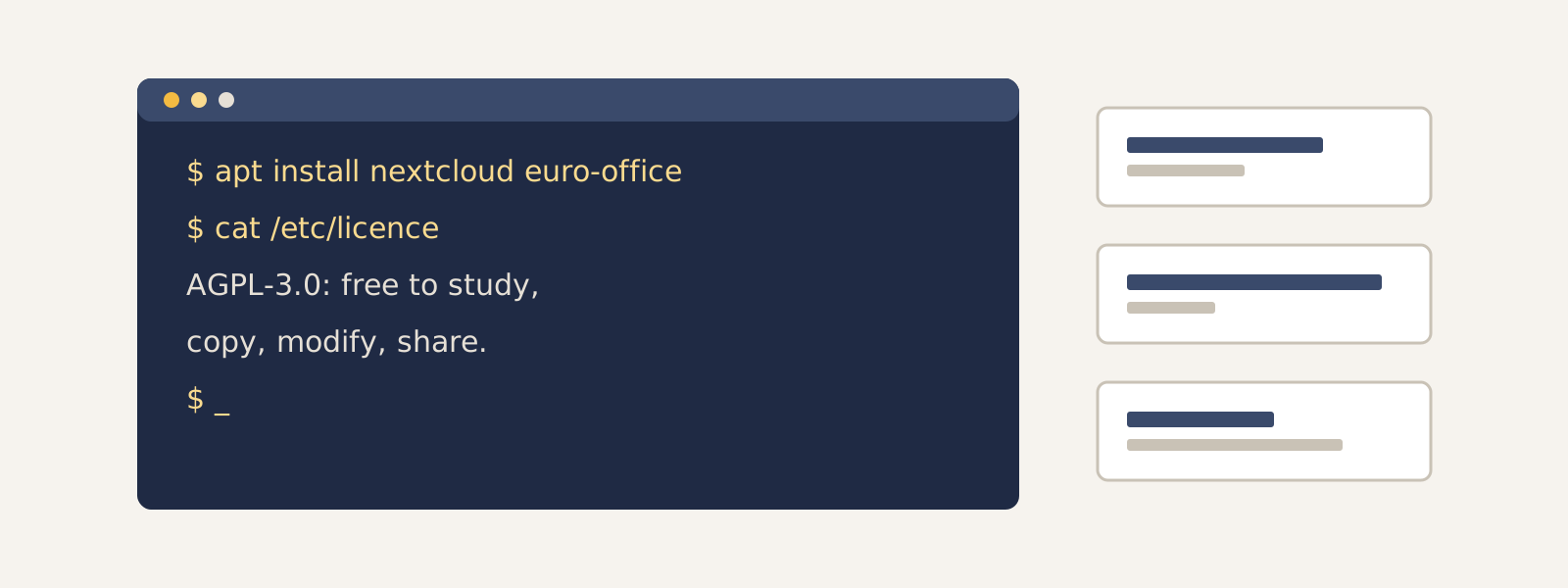
- Nextcloud with Euro-Office or Collabora.The same building blocks as openDesk, assembled in-house: Nextcloud for files, email, calendar and chat, and inside it a browser editor for documents, spreadsheets and presentations. Euro-Office was born in March 2026 from a European coalition led by IONOS and Nextcloud, with AGPL code derived from ONLYOFFICE, stable since 9 June 2026; Collabora Online, derived from LibreOffice, is the editor openDesk uses. It can be hosted on one’s own server or as a service from a European provider.
- LibreOffice on individual PCs.The minimal road, if one wants to change only the office suite without touching email and collaboration. It is the one that saved money for the Ministry of Defence, Umbria and Trentino, and the one Schleswig-Holstein took.
The possible saving for Saronno has a precise order of magnitude: the Microsoft licences cost about €56,000 a year. Not all of it disappears, because a server must be run and people must be trained, but the documented cases below say that recurring spending drops sharply after the first years.
GNU/Linux where Windows 11 will not go
Computers that do not meet the Windows 11 requirements are not thrown away: a GNU/Linux distribution is installed, which on those machines runs better than the system it replaces. One starts from low-risk workstations, where the work is browsing, writing and printing: counters, the library, civic halls, the computer rooms of municipal schools on the South Tyrol model. The French Gendarmerie did so on a hundred thousand workstations, one piece at a time.
Reuse before every purchase
Before every new software tender, the office searches the Developers Italia catalogue and writes in the comparative assessment what it found. What the Municipality has developed, from the website to online forms, is released under an open licence and described with publiccode.yml, as article 69 already requires.
Someone in charge and a calendar
The Digital Transition Officer, a role every municipality must have, coordinates the transition with a multi-year plan: which workstations, in which order, with what training. Migrations without someone in charge and without a political sponsor are the ones that get rolled back.
A council motion
The European campaign “Public Money? Public Code!” provides, also in Italian, a model motion for town councils: software paid for with public money must be released as free software. Adopting it is the policy act that gives cover to the previous steps.
Who has done it
How much was saved elsewhere
The cases that follow have a verifiable source for every figure. Where the number is an estimate and not a final account, it says so.
Province of Perugia, LibreUmbria project · 2012-2014
LibreOffice on more than 5,000 workstations of Umbrian public bodies.
€227,568 saved
Spending of €56,921 against €284,489 budgeted for the proprietary suite: a figure certified by the body itself.
Italian Ministry of Defence, LibreDifesa project · 2015-2020
LibreOffice on about 100,000 workstations.
€26-29 million estimated
An estimate made at the start of the project, not a final account. Declared motivation: savings and compliance with art. 68 of the Digital Administration Code.
Gendarmerie nationale, France · since 2008
GendBuntu, a customised Ubuntu, on 103,164 workstations in 2024 (97% of the fleet).
about €2 million a year
Total cost of ownership cut by about 40%; figures confirmed in a parliamentary answer.
State of Schleswig-Holstein, Germany · 2024-2026
LibreOffice, Linux and open email on 30,000 workstations of the state administration.
about €15 million a year
By December 2025 almost 80% of workstations had migrated. One-off investment of €9 million in 2026.
Swiss Confederation, Federal Chancellery · 2026-2027
Sovereign workplace based on openDesk for 3,000 of the 47,000 federal employees by the end of 2027; the Armed Forces’ Cyber Command moves entirely to openDesk by October 2026.
CHF 9 million for the first phase
Decided after a trial with 172 employees, average score 5.4 out of 6. It will run alongside Microsoft 365, not instead of it: the Chancellery presents it as a reserve of sovereignty and resilience, the army as a necessity, because the US CLOUD Act lets Washington demand data even when stored in Europe.
Robert Koch Institute and other German federal health agencies · 2025
openDesk in operation for about 7,000 users.
reuse of a public suite
The Bundeswehr also signed a seven-year framework contract for openDesk in April 2025; the number of workstations is not published.
Municipality of Rovereto · 2010
OpenOffice on more than 400 municipal workstations.
first municipality in Trentino
A municipality of a size comparable to Saronno, fifteen years ago.
Autonomous Province of Bolzano, FUSS project · since 2005
GNU/Linux in all Italian-language schools.
twenty years of continuity
Recognised as a Digital Public Good. The same free tools at school and in the families’ homes.
Denmark: Ministry of Digital Affairs, Copenhagen and Aarhus · 2025
Exit from Microsoft 365 towards LibreOffice and European services.
digital sovereignty
Declared motivation: reducing dependence on a single non-European vendor. Savings figures not published.
Scaled to a town of 39,000 inhabitants the numbers change size, not sign. The most immediate saving for Saronno is not even on licences: it is on the computers not bought in 2026.
Honesty
What can go wrong
- Munich. The most cited case is also the most controversial. LiMux moved 15,000 workstations to Linux and declared savings of more than ten million; in 2017 the council resolved to return to Windows, and the figures were disputed by both sides. In 2020 the new administration put open source back on the agenda. The lesson is not that Linux does not work: it is that without political continuity, training and someone in charge a migration can be overturned at every election.
- Line-of-business systems do not change in a year.Taxes, the registry, the records office and accounting run on vertical programs, often tied to a vendor. This proposal does not touch them right away: it asks that at the next renewal the comparative assessment be done for real, and that in the meantime exchange formats be open.
- The alternatives are not all equally mature.Euro-Office has a first stable release three months old, a coalition without formal governance and a licence dispute with ONLYOFFICE behind it, since settled; it uses Microsoft formats by default. openDesk is more established but designed for large administrations. LibreOffice is the most proven but covers only the office suite. Whichever road, documents must be saved in OpenDocument.
- The programs tied to Microsoft.Switzerland warns that the hard part is not the suite but the number of applications and specialised systems built around the Microsoft architecture: they must be surveyed first, one by one.
- Alone is not enough. A Nextcloud server must be run, updated and protected: it takes a vendor or, better, a public body above the single municipality, as the Dataport consortium does for five German states. That is why the proposal must also be taken to the Lombardy Region and to ANCI, the association of Italian municipalities. And on large video conferences the Swiss trial showed that these suites still have limits.
- Training costs. The saving on licences comes later, training is paid for first. The cases that worked budgeted for that cost from the start.
- The savings are other people’s. Of Saronno we know the spending on Microsoft licences, not what it would cost to replace them: a server to run, training, programs to adapt. The net saving will be known only after a comparative assessment done for real.
- The real deadline is October 2026.In the European Union Windows 10 receives free updates until 14 October 2026: there is a year to plan, not an emergency to solve tomorrow.
Useful links
- Codice dell’amministrazione digitale, art. 68: analisi comparativa delle soluzioni
Legislative Decree 82/2005, Normattiva
Mandatory comparative assessment and preference for reuse and free software (paragraphs 1, 1-bis, 1-ter).
- Codice dell’amministrazione digitale, art. 69: riuso delle soluzioni e standard aperti
Legislative Decree 82/2005, Normattiva
Code developed for the public sector must be made available under an open licence.
- Linee guida su acquisizione e riuso di software per le pubbliche amministrazioni
AgID, resolution 115/2019
How the comparative assessment is done: reuse and open source first, proprietary software afterwards.
- Linee guida acquisizione e riuso, capitolo “Valutazione comparativa”
AgID, text on docs.italia.it
The three phases of the analysis and the calculation of total cost over time.
- Developers Italia: il riuso del software nella PA
Department for Digital Transformation and AgID
Catalogue of reusable public software and the procedure to reuse it.
- Standard publiccode.yml
Developers Italia
The file that makes a municipality’s software findable in the national catalogue.
- Industry initiative launches Euro-Office as true sovereign office suite
Nextcloud, press release, 27 March 2026
Who promotes Euro-Office, what it is based on and how it integrates with Nextcloud.
- Euro-Office, il codice sorgente
GitHub, AGPL-3.0 licence
The project can be downloaded and verified by anyone.
- Euro-Office, license compliance and what open source means
Nextcloud, April 2026
The licence dispute with ONLYOFFICE, stated among the limits of the proposal.
- Euro Office, l’alternativa open source europea a Microsoft 365 arriva il 9 giugno
ZeroUno
The date of the first stable release.
- openDesk: modelli di esercizio, edizione Community ed Enterprise
ZenDiS, Zentrum für Digitale Souveränität
What the suite is, how it is acquired, requirements and certified vendors.
- Bundeskanzlei lanciert Programm für einen digital souveränen Arbeitsplatz
Swiss Confederation, admin.ch, 2 September 2026
openDesk for 3,000 federal employees by 2027, CHF 9 million for the first phase, results of the trial.
- Switzerland takes a Swiss Army knife to Microsoft 365
ZDNET, Steven Vaughan-Nichols, 11 September 2026
The two Swiss speeds: 3,000 of 47,000 civilian employees alongside Microsoft 365, the Cyber Command entirely on openDesk by October 2026; the reasons tied to the CLOUD Act.
- Determina n. 202 del 4 marzo 2026: acquisto licenze Microsoft 365 Business Premium
Municipality of Saronno, records portal
251 licences for one year, €55,823.91 including VAT: the figure this page starts from.
- EMBAG, legge federale sull’impiego di mezzi elettronici per l’adempimento dei compiti delle autorità
Swiss Federal Chancellery
Art. 9: code developed by the Confederation must be published as free software. The Italian equivalent is art. 69 of the Digital Administration Code.
- Franco-German economic agenda
Élysée, 1 September 2025
France and Germany’s commitment to spread and align openDesk and La Suite numérique.
- La Suite territoriale
ANCT, Agence nationale de la cohésion des territoires
The French State builds a sovereign suite for small municipalities: the model for taking the proposal beyond Saronno.
- openDesk al Robert Koch-Institut: circa 7.000 utenti
ZenDiS, official channel on social.bund.de, June 2025
About 7,000 users at the Robert Koch Institute and in the agencies of the federal Ministry of Health.
- BWI/Bundeswehr chooses open source, adopting openDesk
European Commission, Open Source Observatory
Seven-year framework contract signed in April 2025.
- dPhoenixSuite, la postazione di lavoro sovrana erogata da Dataport
Dataport, public in-house company of five German states
The organisational model: a public body above the single municipality delivers the suite as a service.
- Nextcloud Hub
Nextcloud GmbH (AGPL)
The building block openDesk is built on, usable on its own with a free editor.
- Al Ministero della Difesa il più grande progetto italiano di migrazione a software open source
FPA
LibreDifesa: workstations involved and estimated savings.
- Il Ministero della Difesa risparmierà 29 milioni di euro con LibreOffice
HTML.it
The figure of the LibreDifesa savings estimate.
- LibreUmbria: il software libero nelle amministrazioni umbre
Formez PA, experience database
Certified savings of the Province of Perugia on the office suite.
- Progetto FUSS: software libero nelle scuole della Provincia di Bolzano
Autonomous Province of Bolzano
Twenty years of GNU/Linux in the Italian-language schools of South Tyrol.
- LibreOffice ersetzt Microsoft: quasi l’80 % delle postazioni sulla suite aperta
State of Schleswig-Holstein, press release of 4 December 2025
State of the migration of 30,000 workstations of the state administration.
- Updates on Schleswig-Holstein moving to LibreOffice
The Document Foundation, 13 March 2025
Declared investment cost and annual savings.
- GendBuntu
Wikipedia (with references to primary sources)
The French Gendarmerie on Ubuntu: workstations, total cost and annual savings.
- Question écrite n. 38291 sur le logiciel libre dans la gendarmerie
Assemblée nationale
Parliamentary source on the Gendarmerie’s savings.
- Danish Ministry switching from Microsoft Office 365 to LibreOffice
The Document Foundation, 8 July 2025
Denmark and the cities of Copenhagen and Aarhus leave Microsoft for digital sovereignty.
- La città di Monaco di Baviera saluta Linux
LFFL, November 2017
The LiMux U-turn: what went wrong.
- Monaco ci ripensa (di nuovo): meglio Linux
Mia mamma usa Linux, May 2020
The return of open source in the city’s 2020-2026 programme.
- Public Money? Public Code!
Free Software Foundation Europe
The campaign and the brochure, also in Italian, with the model motion for town councils.
- Fine del supporto per Windows 10: impatto economico e sicurezza informatica in Italia
Hermes Center
Estimate of the electronic waste produced by the forced retirement of PCs.